By the last week of June the afternoons here run on a timetable that has nothing to do with clocks. The morning is bright and dry and faintly dusty, the light goes hard and flat at around three, and then somewhere above the southern sierra the sky turns the colour of wet slate and the first drops land on the pavement like dropped coins. Forty minutes later the side streets are running ankle-deep, the awnings are crowded, and the city has quietly swapped one itinerary for another.
Visitors tend to read this as a ruined day. Chilangos read it as a schedule. The rain is why so much of what this city does best happens indoors, in rooms built for crowds and noise, and why the good version of a June afternoon looks nothing like the good version of a February one.
Why the storm arrives on schedule
Mexico City sits at about 2,240 metres, inside a basin ringed by volcanoes, on the bed of a lake that four centuries of engineering drained and still pumps dry. The wet season runs roughly from June into September, and it is not the all-day grey of a maritime climate. It is convective: the sun heats the valley floor all morning, moisture pushes in from both coasts, columns of cloud stack up over the mountains to the south, and the storm walks north across the city in the late afternoon. Most days it breaks between four and seven, runs hard for forty minutes to two hours, and is finished by dinner. June can add hail, granizo, which arrives with a sound like gravel on a tin roof and leaves white drifts in the gutters that melt within the hour.
The basin has no natural outlet, so every litre has to be lifted out by pump and tunnel. The consequence is local and fast: flat colonias take on water within minutes of the downpour starting, drains back up at the low points, and the Metro stations that sit in those dips can slow or close without much warning. Traffic solidifies. A twenty-minute car journey becomes an hour and a half, and no app will tell you that until you are already in it.
So you invert the day. Mornings are for everything open to the sky: the parks, the canals, the ruins an hour out of town, the long walks. From four o'clock you want a roof, a seat, and something worth doing under that roof for two hours. Five rooms hold up under that, and between them they cover a free hour, a cheap one, a loud one, a dancing one, and one that is still going at one in the morning.
An hour inside the megabiblioteca
Biblioteca Vasconcelos (Buenavista) is the shelter I would send anyone to first, and it costs nothing. Walk in and the building opens into a nave seven storeys tall, with glass-floored reading galleries hung off the walls and steel bookstacks suspended in the void, so that the shelves appear to float in mid-air and the whale skeleton in the middle of it all reads as entirely reasonable. It rewards standing still, which not much civic architecture does, and the rain on the roof glazing makes the central volume sound like the inside of a drum.

Entry is free, there is no cap on numbers, and it is open daily from 8.30am to 7.30pm, so it covers the first half of a typical storm and closes before the second. Large bags go into lockers at the entrance, and if you are a group of six the only real ask is that you keep your voices down, because people are genuinely working here. The garden that wraps the building is the part the rain takes away; on a dry morning it is half the pleasure, in July it is a lake with paths in it.
The location helps as much as the architecture. It stands two minutes from Buenavista station, which puts it on the Metrobús and the suburban rail, so you can reach it and leave it without ever walking far in open weather. Couples, solo readers and families all fit here equally. Arrive by four if you want the hour before the light goes.
The cinema is what people here actually do
Ask a chilango what to do when it starts raining at five and a good number will say, without hesitation, go to the Cineteca. Cineteca Nacional (Xoco) is the national film archive, and the original Xoco complex is the one to aim for: a set of screens, bookshops, a plaza and places to sit that works as a public square with a roof over most of it. Tickets run MXN 50 to 70, roughly US$3 to 4, which is less than the chocolate you will drink afterwards.
The programming is the point. This is restorations, retrospectives, national archive prints and, twice a year, the Muestra Internacional, when the place fills with people who have planned their week around a schedule. Rooms seat hundreds, so groups are easy; buy together online or at the box office and you will sit together. Marquee Muestra screenings sell out days ahead, and turning up on the night of one is how you end up watching your second choice. Check what is playing before you commit the afternoon, because a four-hour archive print is a particular kind of pleasure and not everyone in your party wants it.
There is a second site, Cineteca Nacional Chapultepec, open since 2024 with eight screens, which is the better call if you are already on that side of the city and the traffic has set like concrete. Both work. Xoco has the atmosphere, and the loose, unhurried business of hanging around between screenings is a large part of what you came for.
Under the one roof built for noise
If the storm lands at five on a Friday or a Sunday, the move is Arena México (Colonia Doctores). The Cathedral of Lucha Libre is fully roofed, which is why it holds up in July: the rain becomes background percussion under a crowd of thousands, and the weather outside stops being a variable. CMLL runs the building, tickets go from MXN 200 to about MXN 500 (roughly US$11 to 25), and the two fixtures to know are Friday night, which is the rowdy one, and Sunday afternoon, which is the family show. Sunday is also the one that neatly brackets the downpour.

It takes a group better than the other four rooms here. Book a block on Ticketmaster México and you will sit together; eight people in one row here is a better evening than eight people anywhere quieter. For couples it still works, though it is not an intimate night out: the noise, the vendors, the heckling in rapid-fire Spanish and the theatre of the thing are the experience. Buy ahead for marquee cards, and note that professional cameras are restricted, so leave the long lens at the hotel and take the phone.
One caution specific to the season. Doctores is a working, unglamorous quarter, and it floods. Arrive before the rain rather than during it, and take a taxi or ride-hail to the door on the way out rather than wading to find the Metro.
The dance hall opens two nights a week and no more
Salón Los Ángeles (Colonia Guerrero) has been open since 1937, and in 2026 it turned eighty-nine. Frida Kahlo and Diego Rivera came here. The room is enormous and plain in the way that rooms built for dancing are plain: a long wooden floor, a bandstand, tables around the edge, and a crowd whose ages span sixty years. The house line is that nobody who knows how to dance is a stranger here, which is charming and also a warning. You will be pulled onto the floor.

The schedule is the thing to get right, because people get it wrong and arrive to a locked door. It opens two nights a week only: Tuesdays for danzón and big bands, Sundays for salsa, son and cumbia, 5pm to 11pm both nights. That is it. Entry is MXN 100 to 200 (about US$6 to 11) with drinks on top, tables can be booked by phone for anniversary nights, and the place was built for crowds, so a group is welcome rather than tolerated.
The 5pm start is what makes it a rainy-season fixture rather than a late-night one: you arrive as the storm breaks and leave long after it has cleared. Take a taxi to the door and take one home. Guerrero is not a walk-home neighbourhood after dark, and in July it is not a walk-anywhere one either.
Chocolate thick enough to hold the spoon up
Churrería El Moro (Eje Central, Centro Histórico) has run twenty-four hours a day since 1935, and it is the only one of these rooms still serving when the storm arrives at one in the morning. The original is a narrow, tiled, fluorescent-lit room with a counter, a churro machine turning out rings of dough in front of you, and a clientele at 3am that includes people finishing a shift and people finishing a night. Churros and a cup of chocolate come to MXN 80 to 160, roughly US$4 to 9.
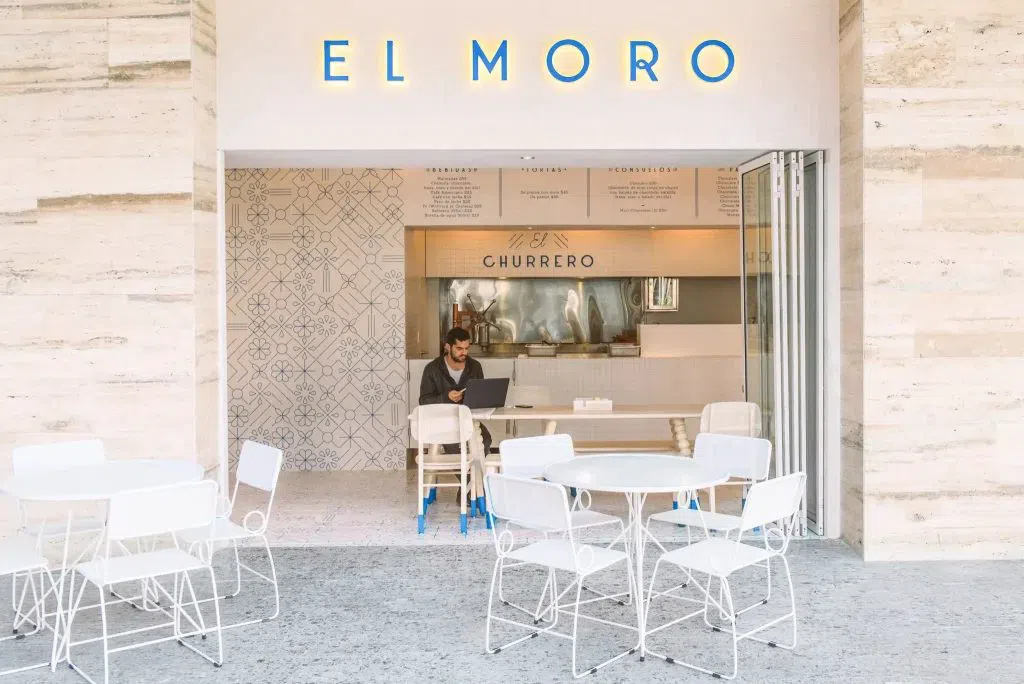
Order the chocolate español. There are four thicknesses on the menu and that is the heaviest, closer to a sauce than a drink, and the right answer when you have arrived soaked and cold, because at this altitude a wet evening gets genuinely chilly. The counter and tables take groups without fuss, there are no reservations at the Centro original, and the turnover is quick enough that a wait is usually minutes rather than a plan. The Condesa, Roma and Polanco branches are more comfortable and run 9am to 11pm; the Eje Central room is the one with the hours and the history.
Putting a wet afternoon in order
The sequences that work are short, because traffic in a downpour punishes ambition. On a Sunday, go to Biblioteca Vasconcelos in the early afternoon, cross the city before four, and take the family show at Arena México. Or skip the arena and be at Salón Los Ángeles for the 5pm opening instead, which is the better call for anyone who likes live bands more than body slams. On a Tuesday, the library in the afternoon and the dance hall from five is as good as the week gets. Any other day, the cinema is the reliable default, and whatever hour you end at, the churrería is open.
For couples, the library and the cinematheque, followed by chocolate. For a group of six or more, the arena then the dance hall, both of which get better the more of you there are. For anyone travelling with children, the library in the day and the Sunday arena card in the late afternoon.
Picking a base matters more in the rainy season than people expect, because a fifteen-minute walk home beats a forty-minute crawl in a flooded taxi every time: see the Mexico City hotel search for where to sit on the map, and the broader Mexico City guide for what to do with the dry mornings.
Practical notes for a wet week
Treat 4pm to 7pm, June through September, as booked by the weather. Front-load the open-air part of the day, and choose one roofed plan before lunch rather than deciding while standing in the rain.
The Metro is cheap and fast and the most reliable thing in the city during a storm, but low-lying stations do flood, so have an alternative line in mind. Ride-hail is fine; prices climb and waits stretch the moment the rain starts, so order five minutes early rather than five minutes late. For Salón Los Ángeles and Arena México, door-to-door by car both ways is the right call after dark.
Carry MXN 500 to 800 in small notes. Entry at the dance hall, the churrería counter and the vendors inside the arena are all easier in cash; the cinematheque and Ticketmaster México take cards.
An entire rainy afternoon runs cheap. The library is free, a cinema ticket is MXN 50 to 70, arena seats MXN 200 to 500, the dance hall MXN 100 to 200 plus drinks, and churros with chocolate MXN 80 to 160. Two people can fill five hours, eat, and see something they will remember for well under MXN 1,000 each.
Bring a compact umbrella and shoes you do not mind soaking, and a layer for afterwards: the temperature drops sharply once the rain has passed, and the city at 2,240 metres gets cold at night in the middle of summer.